Last Monday (Labor Day) was the third consecutive half-day of climbing in the Gunks for Gail and me. We arrived at the cliffs early and without much of a plan. We had talked about maybe doing Apoplexy (5.9) or Retribution (5.10b). But we hadn't discussed a warm-up route.
As we walked into the Trapps I suddenly thought of The Blackout (5.9-), a climb that Gail had introduced me to last year. This climb sits right in the middle of a very popular part of the cliff, near Jackie (5.5), Betty (5.3), Baby (5.6), Son of Easy O (5.8), and others. But no one is ever on it. Last year I had tried the first two pitches (which are both 5.8), combining them in one lead. I got a bit befuddled at the overhang on the traditional second pitch. I stepped up and down several times before committing to the move, getting worn out and then taking a hang during the traverse that came afterwards. I knew I could go back now and do better. And I thought it might be worth looking at the third pitch, which has a G-rated 5.9- roof crux but some allegedly R-rated climbing off the belay ledge up to the roof.
This time around I combined the first two pitches again. They are both very good. The first pitch starts with a fun bulge right off the ground and then, moving a little to the right, presents lower-angled thin face moves up to a ledge beneath the second pitch overhang and traverse. On Monday I brought my red C3 with me because I remembered that last year I found a funky sideways placement for it in a seam to protect the thin face moves.
Everything went well on the first pitch. I found the seam and the funky red C3 placement and danced up to the ledge, enjoying the climbing and feeling good. But Gail insisted that I went too far to the right. She was sure that last year I'd found a different seam, a different funky red C3 placement, and different thin face moves up to the ledge.
Was she right? Who knows? Either way there is pro for the moves and fun 5.8 climbing.
I continued straight into the traditional second pitch, without any hesitation this time around. This is in my opinion the best part of the climb. Once you pull the overhang a balancy move up and right to a pin presents the crux. Then a pumpy traverse right with good holds brings you to yet more steep climbing straight up on jugs to the belay ledge. The pro is good throughout. Save your red and yellow Camalots for the traverse, you'll be glad to have them. This is a really nice sequence. It looks very intimidating from below, but it's all there.
After Gail joined me atop pitch two I walked over to have a look at the R-rated beginning to The Blackout's third pitch. I could see why it is rated R. There is a bolt just over the lip of the overhang but no obvious pro on the face beneath the roof. Any fall before clipping the bolt would send the leader straight down to the ledge. Dick Williams says this unprotected face is 5.8.
As I looked it over, though, it appeared far easier than 5.8 to me. I decided to make a few moves up to evaluate the climbing and see if I could finagle any placements. I figured I wouldn't do anything that I couldn't reverse until I was sure about continuing.
It turned out to be really easy. Maybe I've just been climbing a lot lately and my view is skewed, but I really didn't think it was harder than 5.6 getting up to the bolt. There is this one little reach to the good hold under the roof. I placed a worthless nut over to the left before making this move. The nut immediately popped out but it didn't matter. I knew there was no way I was going to fall off the move, so I wasn't worried. Once I had the good hold in hand I clipped the bolt and it was well-protected and juggy the whole rest of the way. I thought the roof was straightforward and easier than 5.9.
I like The Blackout. The first two pitches are really nice, and different from each other. I am sure I will do them again. I'd feel comfortable going back to do the third pitch as well, but I don't know that I will bother. It just isn't interesting enough. There are much better roof pitches in the Gunks.
Once we got down to the ground I decided maybe I should take a look at another R-rated climb I'd never considered before: Ape Call (5.8).

(Photo: Gail about to make the crux slab moves on the first pitch of Ape Call (5.8).)
Ape Call is just around the corner to the left of The Blackout. The first pitch begins with an R-rated slab. The second pitch ends with a huge roof. Both pitches are 5.8. I've always been attracted to the roof but scared away by the protection rating on the slab. But after my experience on The Blackout, I thought maybe I could check out Ape Call the same way. I could take it one step at a time, not doing anything irreversible, and just climb back down if I thought it was too risky.
It turns out the first moves are no big deal. You quickly find yourself at a stance just a couple of moves from the top of the slab. At just above waist level is a small horizontal seam, with two narrow pockets that take tiny gear. I fiddled with these pockets for a while and got a black Alien to the left, and a purple C3 to the right. I think I got them both well set. I gave these cams some hard tugs, and while there is only so much you can tell from this kind of gear testing, they didn't budge. I thought they were good.

(Photo: Bomber, dude! The crux gear on Ape Call (5.8).)
Then I evaluated the move. Above me was an obvious hold. I figured that if this hold was positive, I could make the one step up and over pretty easily and then place better gear above the lip of the slab. If I reached up and didn't like it, I could still step down and bail.
I stepped up and tested it once, and wasn't sure I liked it, so I stepped down.
Then I stepped up and tried it again and it felt really good. That was all I needed. One step up, plus an easy-does-it step to the right, and I was in good shape. I could reach up and place a perfect cam in the corner above the slab.

(Photo: Gail attacking the huge roof on the traditional pitch two of Ape Call (5.8).)
I really enjoyed the slab. And the rest of Ape Call is better than good-- it is awesome. I ran the two pitches together in one. The remainder of the traditional pitch one has some steep moves up the corner above the slab. Then mellow climbing takes you further up the corner system to the roof. Once beneath the overhang you have to move left to get the good handholds below the lip of the roof. Here you should be careful, because there are several loose blocks that are covered in chalk along the way. Negotiate the traverse left, and then the fun really begins. Move back right, getting fully horizontal under the big roof, grab the jugs in the notch and go!
Ape Call is a great route. It has one of the best 5.8 roofs in the Gunks. And if I am right about the gear then I don't think the start is really R-rated. I would lead it again.
Having done these two R-rated routes, I just had to check out Raubenheimer Special (5.7), another R-rated climb that is in the same area, between Ape Call and The Blackout. I had to do it. It was sitting right there. I'd never been on it before, but Gail had led it and she said it was no big deal. How could I not complete the R-rated trilogy?
Raubenheimer's turned out to be the scariest route of the three, in my opinion. It is a clean route, with good low-angled climbing up an arete and face. But the crux thin move, about 25 feet up, comes above a ledge you will hit if you fail. There really isn't anything much you can do about it. I worked a nut into a shallow placement in a seam to the right, and maybe this nut was good. But the actual climbing is a ways over to the left at the arete, and if you blow the move I don't think the nut will keep you from an ankle-tweaker of a fall. And after stepping up at the crux you need to place a piece in the horizontal over your head from a rather fragile stance. The climbing is rated just 5.7, but I felt I was in much more jeopardy on this route than on the other two. I felt the moves were less secure, less certain. I'm not sorry I did it once but I don't know if I will ever go back.
In writing this post I don't want to encourage you to do something stupid. Please don't go climb one of these routes just because of whatever I may say about them. You have to make your own judgment about the risks.
Really the key insight I gained from climbing these routes is that the decision to climb an R-rated route involves the same sort of thinking that governs every other step you take as a trad leader.
You don't protect every move when you lead, even when the opportunities are there. You need to conserve gear and slings. With every step as a leader you evaluate whether you need to place some protection, or whether you can go a little further. The distance to your last pro figures into the equation, of course, but so too does the difficulty of the terrain. If you're sure you are not going to fall you will be much more inclined to keep running it out a little longer. And so if you are climbing a route with a 5.9 crux, for example, you are going to be making sure you protect the 5.9 moves. And you will be less inclined to place pro during the stretches of 5.6 or 5.7 between the cruxes. You will enter R-rated territory frequently, by choice, when the climbing is beneath your limit. You have to, or you will run out of gear.
The analysis when negotiating an R-rated route is thus similar to any G or PG route. You have to ask yourself with every move whether you are confident you can continue without pro. The only real difference is that if the answer is no, you don't have the option to place a piece. You have to be prepared either to make the move and take a risk, or to bail. If you find yourself unable to do either one, you've made a big mistake.
After I finished Ape Call, Gail asked me how I was feeling while leading the slab. I had to say I just felt good. I wondered aloud about whether courting danger added to the experience, or even represented the heart of the experience of climbing. I'm sure for some people it does.
I have never thought that risking injury was at the core of climbing for me. But it can be hard to know for sure. I like to push my limits. And I surely feed off of the adrenaline rush I get from powering through a tough sequence. If I am, either consciously or unconsciously, flirting with danger becauseit gives me an even bigger rush, then I think I am in an unhealthy place and need to reevaluate what I am doing.
But I like to think I am not in such a place. I enjoyed The Blackout and Ape Call because I evaluated them carefully and continued with the climbing when I was sure it would be okay. I solved both puzzles and felt satisfied physically and intellectually. On Raubenheimer Special, by contrast, when I felt for a fleeting moment that maybe-- just maybe-- I was taking too big a risk, it didn't give me a rush or make me feel good. It actually made me feel a little sick. It was not a feeling I wanted more of.
Labor Day weekend ended my summer with a bang. I hope to get in a few more 5.10 leads before the end of . The autumn,aka Gunkssending season, will soon be upon us. Even if I don't succeed on any new 5.10's, I feel like I've had some good progress this year. The 5.9's all feel pretty good and occasionally I hit a 5.10 just right. My climbing has improved a lot, I think, and I hope to stay healthy through the fall and winter so I can again take it to the next level.


 This is another of the horrid weeds we have here in the desert. I have no idea of any other name for it besides Goathead which really makes people that don't know what it is wonder until they experience the terrible thing. It doesn't look that bad. Doesn't seem to cause allergies. Has a cute little yellow blossom. Grows in a circle that some people, at first, think is a nice growncover as it will grow with no water what so ever. Until you find the seeds which give it it's name, Goathead. The seed are round with two 'horns' that want to break of into the food or hand of what ever encounters it. And it HURTS. Boy does it hurt. I have known of several people who have had to have the 'horn' off of one of these seed surgically removed after it has become infected. One man I know of almost had to have his foot amputated. I was unable to find a seed to take a photo of as I try to keep them all picked up and all plants pulled. They are easy to pull and will die when it freezes, but leaves the seeds to sprout next spring. And each and every seed will sprout. I fight them constantly. Each seed is sent to the trashcan and each plant without a seed is pulled and turned with the root up to die. Several of my neighbors fight them but a lot of people don't fight them and they will stick to anything and make their way back to mine or your yard. They love to hitchhike of car and truck tires and on the rubber soles of shoes, as well as bike tires. They are death to bicycle tires. If you ride a bicycle in the desert you are sure to go buy the special tubes that can't be punchered by the 'goathead seeds'. And of course dogs and cats hate them as well as those of us that try to get rid of them. Again this weed is not native to the desert but I don't know where it did come from
 It kept following me around, so finally I took a picture.


 On the road, we see for the first time the exquisite countryside views of Andalusia. It reminds me of Crete, Greece for its rolling valleys of olive tree plantations and white-washed villages and Nevada, USA as well for the dessert-like expanse and the rock mountains.

 So my OVI review:


 File this under "duh" if you will, but I need to acknowledge this out of fairness to Rivendell, and as a means of providing information to others wondering just how much of an effect one's positioning on a bike can have on pedaling effort and speed. Earlier I described being considerably faster, particularly uphill, on the Seven bicycle I have on loan in comparison to my Rivendell Sam Hillborne. It was widely agreed that there were many factors involved in this difference - from frame geometry, to weight, to positioning. For some time now I'd been considering making changes to my Rivendell, and finally it's been done - thus somewhat leveling the playing field between the two bikes, with interesting results.
 We've also reduced the amount of setback on the saddle by about 2 cm (not just by moving the saddle forward, but by replacing the seatpost). The overall effect is that my lean has increased by a small amount, my weight on the bike has shifted forward, and my hips are move directly above the cranks.
 We rode to Lexington, MA to try some hill intervals. I did not attach a saddlebag, so that I could get a sense of how the bike itself performs. And it performed well - albeit differently from the Seven.
 Having just returned from our stay on Cape Cod, I am greeted with a remarkable development: There are now bike lanes on one of the most hated stretches of road near my neighborhood. While normally I avoid this road, today I found reasons to travel along it multiple times just to experience its Disneyfication - for the city has also planted trees and installed decorative streetlights, in attempts to disguise the faded vinyl-siding of the multi-family homes and the peeling storefront signs that say things like "Used Tires". Why if Boston keeps this up, soon the last of the gritty neighborhoods will turn shiny and pleasant and there will be nothing to complain about!
 1. Positioning within the bike lane
 2. Passing other cyclists
 3. Yielding to turning vehicles
 5. Positioning when stopped at intersections
 6. Turning
 7. Wrong way in the bike lane?
 8. Cycling onto the sidewalk
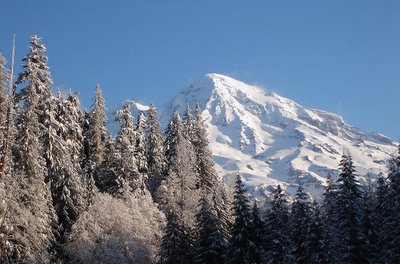 A classic Mount Rainier image to start the week, taken last Friday after the last major snow. More soon...
 I love cherries. They are my favorite fruit. And I love fruit. There are lots of kinds of cherry trees. The Bing is the most common but my favorite is the Black Tartarian. I have two of them and usually only get a few of the cherries as the birds get most of them.